NorthStar Academy
15 Years Anniversary
How Difficult Is the EA Exam Pass Rates & Strategy Guide
👤 Shahrukh📅 08 Jul, 2610 min read

How Difficult Is the EA Exam? Complete Guide to Pass Rates, Challenges & Preparation

Across the accounting, tax and finance sector, the Certified Enrolled Agent (EA) credential has emerged as a highly sought after by accounting and taxation professionals seeking a career in the U.S. tax field. The qualification is directly authorized by the IRS, and thus has much credibility in the global tax industry.

But before embarking on the journey, many students ask themselves the same question, how difficult is the EA exam?

There is no one right or wrong answer because this will depend on several factors including, but not limited to, your accounting experience, the way you prepare your accounting, accounting concepts, and consistency. The exam is not as intimidating as some of the more involved accounting exams, but it will still require some work and study.This complete enrolled agent exam guide  covers the explanation of the exam structure, the pass rates and hardest sections, tips on preparing for the exam, and some helpful hints to understand the true difficulty level of the EA exam in 2026.

Understanding the EA Exam Structure

Before taking a look at EA exam difficulty, it’s important to understand how the qualification is designed. The Special Enrollment Examination (SEE) is an exam developed by the Internal Revenue Service (IRS) that evaluates a candidate's understanding of the tax laws of the United States and the related tax procedures. 

The paper has three parts:

EA Exam Part

Main Focus Area

Part 1

Individuals

Part 2

Businesses

Part 3

Representation, Practices & Procedures

Both papers consist of a number of multiple-choice questions to test practical tax knowledge and skills of application.

The IRS EA exam format is computer-based and scored on a scale of 40-130. Each section has a minimum score of 105.

This is a certification that is more focused on applying taxation law, filing, ethical issues and compliance procedures, unlike many other accounting qualifications which are more theory based.

There are three sections in the qualification and many candidates make the assumption that it is easier due to its shortness. The syllabus is detailed, though, it is updated frequently in line with IRS regulations and tax law changes. The difficulty of the EA exam parts also varies from one another.

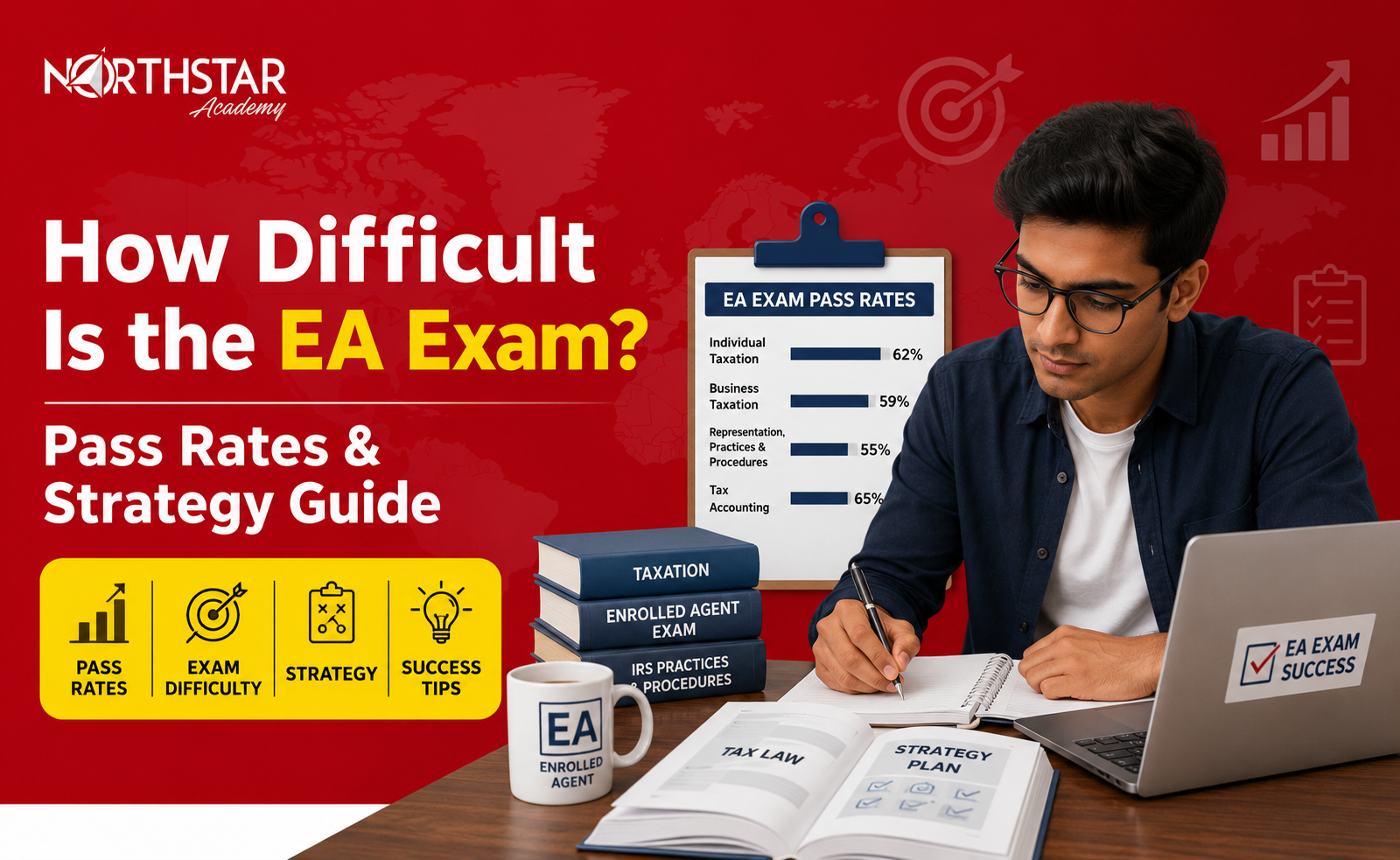
EA Exam Pass Rates – How Hard Is It Really?

A useful way of assessing the qualification is to review trends in the proportion of pupils successfully achieving the standard over time.

The average percentages of students who pass the exams are estimated as follows based on recent EA exam statistics:

Exam Part

Approximate Pass Rate

Part 1 – Individuals

60–70%

Part 2 – Businesses

55–65%

Part 3 – Representation & Procedures

75–85%

On the surface it may seem like these numbers make the certification look less difficult than other professional accounting certifications. But, the overall challenge is not only determined by the rates of passing.

For instance, numerous candidates working on obtaining this accreditation have some prior experience in taxation, accounting, or finance. This, naturally, has an impact on the overall pass rate of candidates.


Part 2 always has the lowest scores because it includes topics from the business taxation such as:

  • Partnerships

  • S corporations

  • Corporate taxation

  • Estate taxation

  • Business deductions

Part 3 tends to be the most successful part due to its emphasis on ethics, procedures and representation rules.

One common pitfall of those who failed to pass the exam is not being prepared enough. The shorter course length than CPA and CA means that, at times, learners think they can obtain the qualification by doing little study.

Is the EA Exam Hard Compared to Other Accounting Exams?

One of the recurring topics that accounting students are discussing is EA exam vs CPA difficulty. Both qualifications have high career prospects but they are suited to different career options.

The CPA qualification is more general and learned. It addresses a number of aspects including:

  • Auditing

  • Financial accounting

  • Business regulations

  • Reporting standards

  • Taxation

  • Advisory services

The broad scope of the syllabus means study times are typically longer and concepts are more complex in various areas of accounting when preparing for the CPA.

The EA qualification, on the other hand, is much more specialized. It deals primarily with taxation in the United States, IRS guidelines, tax filing methods, and representation rights. This is one of the reasons why many candidates ask, is EA easier than CPA.

Most students will say yes. Overall, the qualification is generally believed to be more manageable due to:

  • The syllabus is reduced in size.

  • It consists of only 3 parts!

  • It's easier to prepare than normal

  • Much of the focus continues to be on taxation.

The difference becomes even more apparent when speaking of the EA vs CMA comparison. CMA is more about:

  • Management accounting

  • Financial planning

  • Cost analysis

  • Performance management

Students focusing on taxation and compliance tend to be more at ease with EA, whereas students focusing on corporate finance tend to prefer CMA.

The qualification is easier than CPA for tax professionals, working candidates and people who work in US taxation. There are some comments on Reddit about this, but they don't have a clear comparison that goes into the reasons of its overall toughness based on career background and specialization.

Key Factors That Make the EA Exam Difficult

Depth of Tax Knowledge Required

The reason the EA exam is difficult is the amount of IRS tax code knowledge that is needed to prepare for it. Candidates should be well acquainted with the topics such as details of deductions, credits, filing rules and compliance procedures for individual taxation. Additionally, the IRS makes changes to the tax laws on an almost regular basis, adding to the complexity of preparing. Tax concepts don't suffice as there are practical situations where candidates will have to apply the tax rules. Students with no previous contact with the IRS often find IRS terminology, forms, and complicated tax structures to be difficult to understand and use in preparation.


Wide Syllabus Coverage

The syllabus is comprehensive and covers areas such as individual taxation, business taxation, representation, ethics and IRS procedures. Students will be required to study a number of different tax scenarios from various categories of taxpayers. Some of the biggest challenges with the EA exam is preparing for both individual and business tax. The ethics section is also one that demands a high level of attention to their professional responsibilities and the rules and regulations of the IRS, making it more challenging for a number of students.

Technical Concepts in Part 2

It is the hardest part of EA exam study plan, as it involves a lot of business taxation concepts. Partnerships, corporations, S corporations, business deductions, and other aspects are complex areas that need to be understood and applied. Candidates need to understand the tax treatment of various types of business entities under IRS guidelines. These technical areas tend to be challenging for beginners as they involve analytical questions with the need for good conceptual clarity and regular practice and revision.

Time Management During Exam

Another big problem during the EA paper is time management. There are many lengthy ‘scenario' questions, which will be read carefully and analysed before marking the answer. If pupils spend too long on challenging questions they may not finish the paper with a degree of comfort.

Lack of Structured Preparation

A significant number of pupils do not plan their studies or revision well. Consistent practice, mock tests and scheduled learning is essential to ensure candidates don't miss out on important taxation topics. When there is no organization there are two main issues: less confidence and more confusion in the overall process of organized preparation.

Which Part of the EA Exam Is the Hardest?

Part 2 – Businesses is the most difficult EA exam part, for the majority, across all three sections.

The primary one is the complexity of business taxes.

The topics covered in Part 2 are:

  • Corporate tax rules

  • Partnerships

  • Business deductions

  • Depreciation

  • Trusts and estates

  • S corporations

These areas are more complex than taxation of individuals.


Difficulty Ranking of EA Exam Parts

EA Part

Difficulty Level

Part 2 – Businesses

Hardest

Part 1 – Individuals

Moderate

Part 3 – Representation & Procedures

Easiest

Part 1 is deemed to be manageable for candidates who are familiar with the concepts of personal taxation.

Part 3 is generally less difficult, as it will have an emphasis on ethics, representation rules and procedures rather than extensive calculations.

But the challenge is different for different sets of professionals. 

Tax scenario analysis is a common requirement that candidates must be prepared to handle, as well as determining the proper treatment and applying IRS rules properly. It is crucial to score highly on this section because one should practice and conceptualize it well.

How Long Does It Take to Prepare for the EA Exam?

Typical EA exam preparation time is:

  • 2–4 months per section

But there are a number of factors that influence the preparation time:

  • Academic background

  • Tax knowledge

  • Working schedule

  • Daily study hours

  • Previous accounting experience

For the working professional, the preparation time could be longer due to less time for study during the weekdays.  People from commerce or taxation backgrounds are likely to prepare quicker than those with no prior background.


Recommended Study Hours

The successful candidates dedicate about 120-150 hours to prepare for each section.

Typically the most effective study habits are multiple smaller study periods throughout the day rather than one lengthy study period from time to time.

Two challenging hours a day are generally more beneficial than an unplanned use of the weekend for study.

Full-time candidates tend to finish the syllabus sooner as they are able to put in more revision and practice time regularly. The working professional typically requires more time management and disciplined scheduling, however.

How to Pass the EA Exam Easily (Proven Tips)

The best way to pass the exam is to have the right EA study strategy. Follow a Structured Study Plan 

Divide the syllabus into weekly targets.

Don’t study in an unplanned way. Having a definite study plan helps in retaining information and also reduces stress.

Take Mock Tests Regularly

Mock tests help candidates in:

  • Improve speed

  • Understand question patterns

  • Build confidence

  • Reduce exam anxiety

Daily MCQ practice is a must for success.

Concentrate on the weaker spots

Avoid spending too much time on easy topics.

Recognize the lower level concepts at an early stage and give extended practice time

.

Use Updated Study Material

Taxation legislation is constantly evolving. Always use the latest study material according to the latest IRS guidelines and exam patterns.

Revamp IRS Publications

Many candidates refer to IRS references and publications to improve their preparation. This helps in grasping the concepts as well as the application skills.

Another useful practice is to keep abreast of important tax rules, deductions and filing procedures in brief revision notes. These short notes play a very useful role in revision before the exam or assessment. Candidates are expected to review errors made in mock tests rather than just review the scores. Learning the reason for the wrong answer aids in comprehension and helps to minimize the likelihood of committing the same error again when preparing. Regular revision also boosts long term memory and confidence levels.

Common Mistakes That Make the EA Exam Harder

Many students make unnecessary preparation errors, creating an unnecessary increase in the difficulty. 

Common issues are:

  • Skipping practice tests

  • Ignoring the complexity of Part 2

  • Poor revision habits

  • Passive reading: using only top-down and down-up reading strategy

  • Poor exam time management in tests or assessments.

  • The use of old study material.

Postponing revision until the final stage of preparation is another common mistake and one major reason explaining why candidates fail EA exam attempts.

If there's no revision, it's hard to retain.

If the students are actively practicing MCQs and mock tests, they generally score high marks as compared to students who have only read the theory notes.

Inconsistent study schedules reduce retention, while disciplined daily learning improves confidence, focus, consistency, and long-term learning outcomes significantly.

Is the EA Exam Worth It Despite the Difficulty?

Indeed, the EA qualification is seen as extremely beneficial for taxation professions.

One big advantage of enrolled agent certification is that the IRS grants it. This allows EAs to represent taxpayers to the IRS.

Career opportunities include:

  • US Tax Analyst

  • Tax Consultant

  • International Tax Associate

  • Compliance Executive

  • Tax Advisory Professional

There is continued demand for U.S. taxation professionals around the world, particularly in outsourcing providers and multinationals and at the Big 4.

Students should also understand the overall EA exam fees, registration costs, and study expenses while planning their certification journey.

EA is specifically very valuable for students interested in taxation for their long career.

Conclusion – How to Crack the EA Exam Smartly

The EA paper  is difficult, but can be passed with good preparation and perseverance.

The level of difficulty of the syllabus is not a problem for most candidates; it is the fact that they may not know about the concepts in taxation adequately or do not have a systematic approach for their preparation. This EA exam difficulty summary highlights that the overall challenge depends more on approach and understanding than difficulty alone.

A good approach is to:

  • Consistent study hours

  • Mock test practice

  • Updated material

  • Strong revision habits

  • Focus on weak areas

By following good preparation and guidance, the qualification can be achieved. Students who follow a structured mentorship program, such as NorthStar Academy, get resources organized and guidance from the experts and support in preparation for exams all the way.

Frequently Asked Questions

Is EA exam easier than CPA?

Yes, most candidates consider EA easier because it focuses mainly on taxation. Students wondering is EA exam easy or hard usually find it manageable compared to CPA.

Can a beginner pass EA?

Yes. Beginners can clear the exam with consistent preparation, structured study plans, and regular practice using updated study material.

Which EA part should I take first?

Most students begin with Part 1 because it builds foundational tax knowledge before moving into business taxation concepts.

What is the passing score?

Candidates need a scaled score of 105 out of 130 to pass each part of the SEE examination.